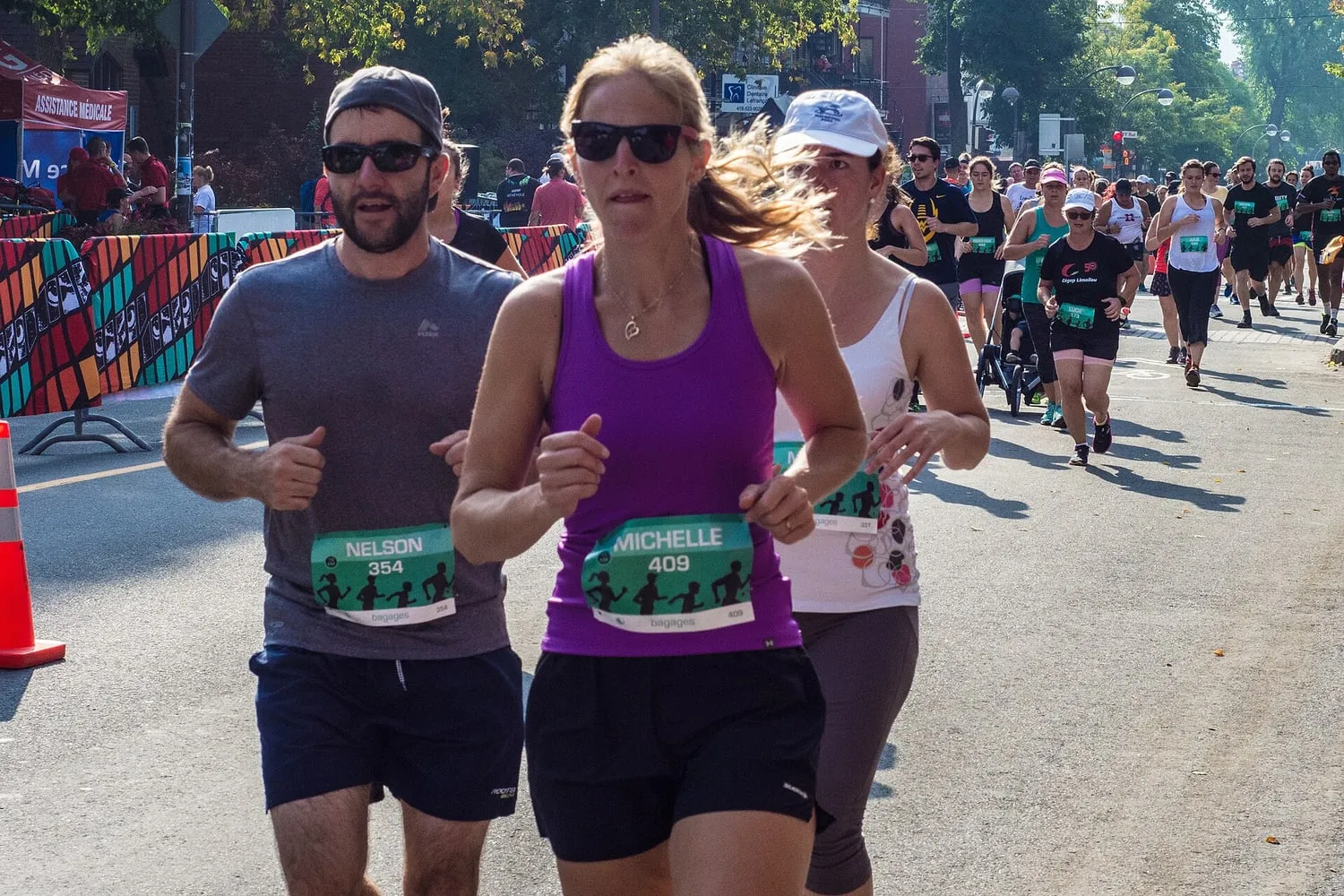
Every summer a new crop of garments claims to keep the wearer cool. The claim is usually attached to a fibre additive or a surface treatment, and it is usually the smallest factor in the outcome. What decides how a body behaves in heat is air movement, sweat evaporation and radiant heat load, and a garment affects all three through its weight, its structure, its colour and how closely it sits.
The instinct to train in as little as possible is sound up to a point and wrong past it. Exposed skin does lose heat well by convection and evaporation. It also absorbs radiant heat from the sun directly, so on a bright day an uncovered shoulder and back take on heat that a light, loose layer would have reflected or blocked. The useful question is not how much skin is covered, but whether the layer over it obstructs evaporation.
Evaporative cooling and humidity#
The body sheds heat in hot conditions mainly by evaporating sweat from the skin. Sweat that drips off has removed almost no heat. Sweat that evaporates on the skin has removed a substantial amount, because evaporation takes energy from the surface it leaves.
Humidity sets the ceiling on that mechanism. In dry air, evaporation proceeds quickly and the limit is sweat production. In humid air, the vapour pressure gradient between skin and air narrows and evaporation slows, so the same sweat rate produces less cooling. A fabric cannot change the humidity of the air around the body by much, which is why claims about cooling fabrics should be read against the fact that the ambient air is doing most of the work.
The practical consequence is that in humid conditions, the fabric’s job shifts from transporting liquid to simply not impeding evaporation. A dense, heavy knit that holds liquid against the skin is the wrong choice, and a light open structure does better even if it transports water less efficiently.
Airflow against coverage#
Air movement across the skin is the second mechanism, and it is the one a garment can affect most directly, because fabric that sits flat on the skin blocks it.
A loose cut allows air to pass between the skin and the fabric, which promotes evaporation even when the wearer is moving slowly. A tight cut eliminates that gap, so any airflow has to pass through the fabric itself. That is the argument for open structures: mesh panels, eyelet knits and loose weaves allow air to move through rather than around.
The counter-argument is that a loose garment moving a great deal can chafe over distance, and it can catch wind and cost energy on a bicycle. A working compromise is a close fit in areas that must not move and an open structure or a looser cut over the back, the chest and under the arms, where most sweat is produced.
Colour, solar load and fabric weight#
Radiance from the sun adds heat, and colour changes how much is absorbed. A dark garment absorbs a large share of the visible and near-infrared energy falling on it, which raises the fabric surface temperature above air temperature. A light garment reflects more of it, so it sits closer to air temperature. The difference is greatest in direct sun and disappears in the shade, which is why a light top and a dark top perform similarly in an indoor studio.
Fabric weight matters in a simple way: heavier fabric holds more water before it feels wet and takes longer to dry, so it is the wrong choice for a hot session. Single-layer knits in the region of 120 to 170 gsm dry quickly and feel light. Above roughly 200 gsm, a knit holds more liquid and becomes harder to evaporate from.
Construction details count for less than these three factors, and woven stretch fabrics typically feel hotter than knits of the same weight because the structure is denser and passes less air.
Open structures and where they belong#
Mesh is a family rather than one fabric. A large-hole mesh used as a panel ventilates and dries very fast, and it offers little opacity or abrasion resistance. A fine power mesh used for compression has a closed structure, holds shape and passes relatively little air. Reading the fabric rather than the name prevents a common mistake.
A useful arrangement for hot conditions is a light knit over most of the body with mesh where heat accumulates: the centre back, under the arms, behind the knees. Panels cost more to make because they add seams, and seams are also where chafing starts, so placement matters.
Skin, sun and the limits of the garment#
Clothing is the more reliable sun barrier than sunscreen where there is a choice, because coverage does not need reapplying and does not wash off with sweat. Fabric sun protection is roughly a function of how much light the weave blocks, so a dense knit protects more than an open mesh, and a wet or worn-thin fabric protects less than the same fabric when dry and new.
Hydration sits outside what a garment can influence, and the honest position is that drinking to thirst during a session, and starting a session reasonably hydrated, is the behaviour that matters most. A garment that feels cooler does not change how much fluid the body is losing. Heat adaptation, pacing and time of day are decisions with more effect than any fabric choice.
Reading cooling claims#
Claims about cooling fabrics take a few recognisable forms.
- Conductive finishes. A treatment that increases the rate at which the fabric conducts heat away from the skin, which is measurable on a flat sample and smaller in wear than the quoted numbers suggest.
- Modified yarn cross-sections. A yarn shape that spreads moisture faster across the fabric surface, which speeds drying once the liquid has moved.
- Evaporative effects. An effect that depends entirely on airflow, so it works in a breeze and does nothing in a still room.
None of these descriptions is dishonest by itself. What they share is dependence on conditions: air movement, humidity and the fit of the garment over the skin. A cooling claim on a garment that fits flush against the back is largely inert, because there is no air to work with.
A rule for hot sessions#
The default that works across most hot-weather training is a light, single-layer knit in a light colour, cut close enough not to flap but not so close that it sits flat on the skin, with mesh or an open structure where sweat collects, and no second layer on the torso. For sun exposure, cover the shoulders and the back with fabric rather than relying on sunscreen alone, and choose a tighter weave over the areas most exposed.
Then apply the test that matters: a garment that feels heavy when wet, clings in sheets or holds water for the length of the session is costing more than it returns, whatever its label says. Weight and openness are judged in the hand before purchase, and they predict performance in heat more reliably than any added treatment.