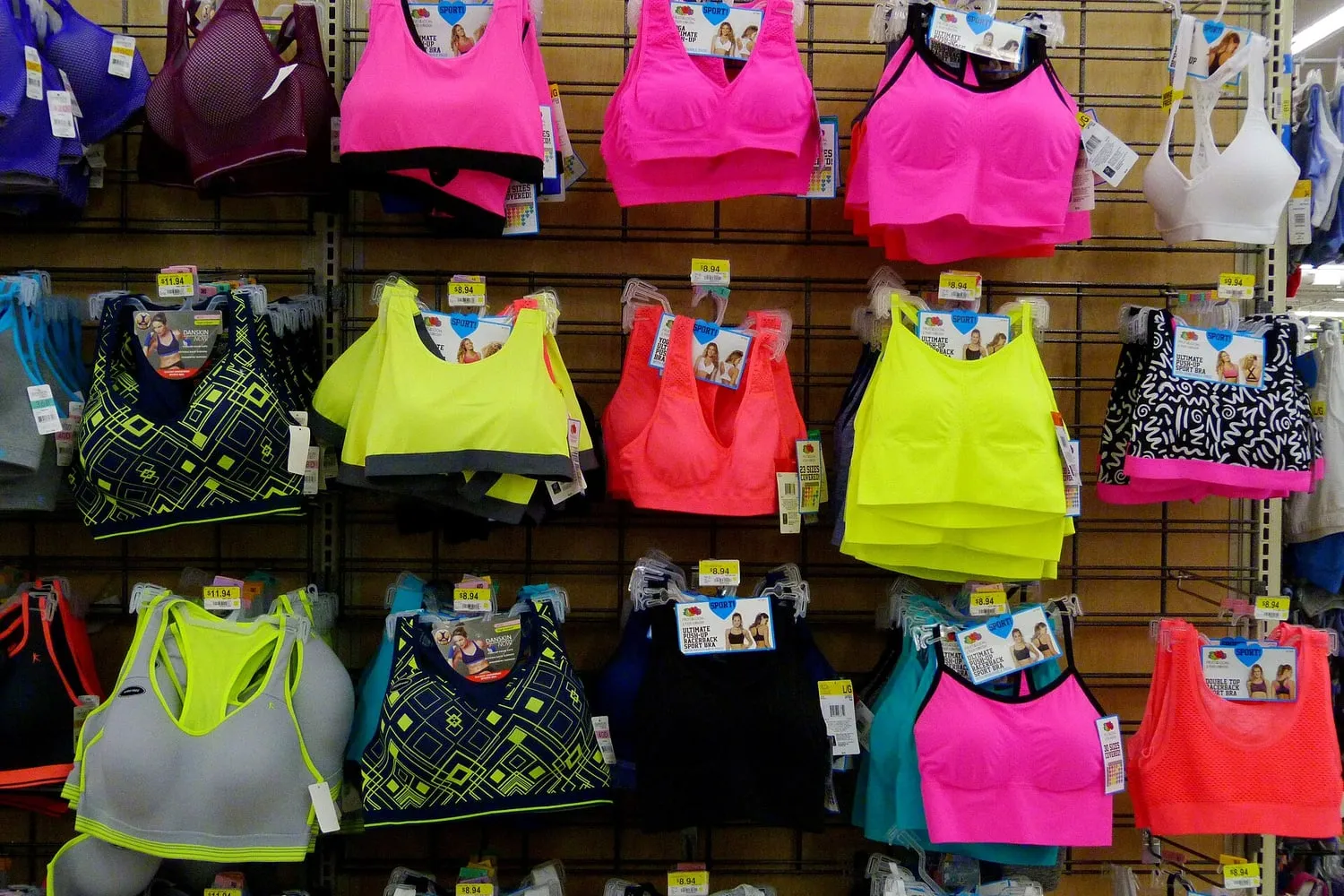
A common instinct when a sports bra feels unsupportive is to go down a band size, on the assumption that a tighter band must hold more. The effect is usually the opposite. The band carries most of the load, and it does that by gripping the ribcage across a wide area without pinching it. Shrink the band and the elastic can no longer lie flat, so pressure concentrates into a narrow strip, the back rides up, and the bust moves more than it did before.
Support is a construction problem rather than a tightness problem. Breast tissue has no muscle of its own. It is held by skin and by the Cooper’s ligaments, which stretch under repeated unsupported movement, and a bra works by limiting how far that tissue travels. Doing so over a broad, stable contact area works better than squeezing hard at a few points, and it is far more comfortable across a long session.
The band is the load path#
The band carries the greater part of the load and the straps carry the remainder. That ratio is why band fit decides whether a bra works at all. An underband should sit level all the way round, parallel to the floor, and stay there when the arms go overhead. If it lifts at the back or rides up over the ribs, the bra is not anchored, and the cups move with it.
Construction matters as much as width here. A wide underband with an elastic that is knitted or woven into it holds its shape better than a narrow strip of exposed elastic, which folds and digs when the torso bends. Look for a band with a firm, dense feel and a clean finish on the inside, since a rough edge against the ribcage becomes obvious over a long run. Elastic quality decides how the band ages: good underband elastic returns to its original length after stretching, and poor elastic does not.
Check the closure where there is one. A hook-and-eye panel with three or more columns allows the band to be tightened as the elastic relaxes, which extends useful life. A bra with a single fixed hook position has no adjustment left once the elastic gives.
Encapsulation against compression#
The two main ways of building support behave differently. Compression presses the bust against the chest wall, limiting movement by holding everything as one mass. Encapsulation gives each breast its own shaped cup, so movement is restrained within the cup by seams and panels rather than by pressure.
Compression suits smaller busts and lower-impact sessions, and it tends to be simpler, lighter and cheaper to make. Encapsulation suits larger busts and higher impact, because it distributes load through the cup structure rather than pressing everything flat. Many bras combine the two, pairing seamed or moulded cups with a firm band.
For running, and for any session with a jumping or bounding element, encapsulation or a hybrid generally controls movement better. For lifting, cycling and studio work, a compression bra that stays put is often enough, provided the band is right.
Straps, hooks and adjustment#
Straps should be wide enough to spread load and should not cut into the shoulder or press on the trapezius. Adjustment matters more than width: a strap that can be shortened as its elastic ages keeps the fit stable for longer. On larger sizes, straps that adjust at both the front and the back are easier to set accurately.
Racerback and cross-back designs move the straps towards the centre of the back, keeping them clear of the shoulder joint and out of the way of the shoulder blades during overhead work. The trade-off is that they are harder to get on and off, and on a long torso the straps can pull on the neck.
Underwires are a structural choice rather than an upgrade. A wire that sits on breast tissue rather than on the ribcage will rub, and a wire too narrow for the cup will sit forward of the rib line. If a wired bra leaves a mark along the breast rather than under it, the cup shape is wrong for that body.
Cups, seams and fabric recovery#
Cup seams shape and stabilise the cup, and they also create edges. A seam that crosses the front of the cup during a long run can chafe, so smooth or bonded seams matter for high-mileage sessions. Moulded cups have no front seam but rely on foam, which holds shape and can crease when washed hot.
The fabric needs two properties: it must move moisture away from skin, and it must recover. Elastane content in the band and cups governs how the garment holds its shape. A high proportion of elastane stretches well and loses recovery faster under heat and chlorine, so a knit with moderate stretch and a stable structure often keeps its fit longer than a very stretchy one.
Check the inner surface against the skin. Uncovered elastic, a scratchy seam allowance or a heat-transfer label at the centre back are all common causes of rub in a garment that fits well otherwise.
Alpha sizes against band and cup sizing#
Alpha sizing, in small, medium and large, works for compression styles where the fabric does the work, and it is simpler to buy without trying on. Band and cup sizing gives a closer fit and is usually the better route for larger busts and higher-impact training, because the load path is set by the band rather than by a general body size.
A useful rule when comparing the two systems is to start from the underband measurement, taken snugly around the ribcage directly beneath the bust, because that is the number the band is built to. Compare that with the band size on the label rather than with the alpha size.
Judging one in the fitting room#
A short routine settles most of it, and it takes about a minute.
- Set the band on the loosest hooks. That is the setting a new bra will live in, and the band should sit level and stay level with the arms raised.
- Bend forward, then side to side. Watch for the band riding up and for the bust moving inside the cup rather than being held.
- Press a thumb under the front of the band. If it lifts away easily, the band is too loose.
- Check the centre front panel. It should sit against the sternum rather than standing away from it.
- Look at the finish details. Seams should not cross the front of the cup, the underband should be covered, and any label should be printed rather than sewn.
When a bra is finished#
A sports bra is done when the band no longer recovers, when the straps have stretched past their adjustment, or when the cup fabric has lost its shape and no longer controls movement. Those changes arrive gradually, so the working test is comparison: check a used bra against a new one in the same size and pull both bands. If the older band extends noticeably further under the same pull, the support has already gone. Replacing on that evidence is more reliable than replacing on appearance.